
Key facts for Conroe sleepers
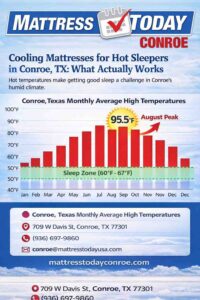
Conroe summers hit 95 degrees F with a heat index near 124 degrees F. If you are waking up warm at 2am, here is why your mattress is making it worse and what to do about it. Average annual humidity in Conroe is 75%, peaking at 80% in February and staying above 69% all summer, increasing the demand for cooling mattresses for Hot Sleepers.
This guide is written specifically for Conroe, Texas residents. The climate here, hot, humid, with overnight lows that rarely drop below 74 degrees F from June through September, creates a specific set of sleep problems that general mattress advice does not fully address.
STAT |
DETAIL |
| Conroe August heat index | Averages 123.8 degrees F, one of the highest in the continental US (Weather Atlas) |
| Average annual humidity | 75% year-round, peaking at 80% in February, staying above 69% all summer |
| Overnight lows July and August | Rarely drop below 74 degrees F, meaning bedrooms stay warm all night |
| Recommended sleep temp | 60 to 67 degrees F (Cleveland Clinic) — nearly impossible without AC in a Conroe summer |
| Deep sleep loss from heat | A 1 degree C rise in core temp cuts deep sleep by up to 15 minutes per night (Journal of Physiological Anthropology, 2023) |
| Gel foam cooling duration | Fades after 1 to 2 hours in warm, humid conditions (Sleep Research Society, 2022) |
Why Conroe Summers Make Hot Sleeping Worse Than Almost Anywhere
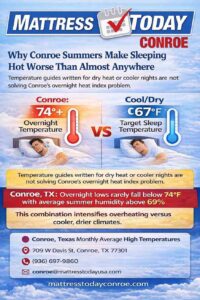
Most sleep temperature guides are written for places with dry heat or cooler nights. Conroe is neither of those things. From June through September, overnight lows stay above 72 degrees F. That means your bedroom is already warm before you lie down, and your AC is fighting ambient heat all night just to stay near the recommended 67 degrees F sleep threshold.
The humidity makes it measurably worse. At 75% average annual humidity, sweat does not evaporate off your skin the way it does in a dry climate. Your body holds onto heat longer. The mattress absorbs and traps that heat. The combination is what turns a warm night into a restless one.
| In Conroe, TX, hot sleeping is intensified by overnight lows that rarely fall below 74 degrees F combined with average humidity above 69%, which slows the body’s natural heat release and increases mattress heat retention compared to drier or cooler climates. |
The heat index problem no one talks about at bedtime
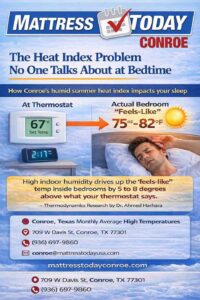
Conroe’s July heat index hits 123.8 degrees F during the day. That number drops significantly at night, but the residual humidity in the air and trapped in your home’s walls keeps your bedroom warmer than the thermostat suggests.
The “feels like” temperature inside your bedroom can be 5 to 8 degrees F higher than what your thermostat reads, according to thermodynamics research cited by Dr. Ahmed Harhara, a Houston-based engineer who studies residential heat transfer.
A mattress that traps body heat does not just affect your comfort. It actively works against the biological process your body runs to enter deep sleep. That process requires your core temperature to drop. In Conroe’s humid summer nights, that drop is already harder to achieve. A heat-retaining mattress makes it harder still.
| Customer’s Testimonial:
I have tested mattresses in climate-controlled labs and in real home conditions. The difference between those two settings matters most in places like Conroe. A mattress that performs adequately in a 68 degree F, 40% humidity room can feel noticeably warmer in a Conroe bedroom in August, even with the AC running. If you are buying a mattress for this climate specifically, you need to account for that gap and buy Cooling Mattresses. |
How Do Cooling Mattresses Actually Work?
A cooling mattress does not feel cold when you lie down. The word “cooling” refers to what it does with heat over several hours, not how it feels at first contact. The goal is to keep the temperature at the sleep surface stable rather than letting it climb through the night.
| Cooling mattresses work by using breathable materials like open-cell foam, natural latex, or copper-infused foam that allow body heat to disperse away from the sleep surface rather than accumulate against the body throughout the night. |
The four cooling technologies and how they hold up in humidity
| MATERIAL | HUMIDITY PERFORMANCE | OVERNIGHT STABILITY | CONROE VERDICT |
| Natural latex | Humidity-resistant | Stable all night | Best for Conroe |
| Open-cell foam | Good airflow | Consistent overnight | Strong choice |
| Gel-infused foam | Fades after ~2 hrs | Weaker in humidity | Use with caution |
| Copper / graphite foam | Conducts heat fast | Newer, limited data | Promising |
Natural latex is the most humidity-resistant option. Its open-cell structure is natural, not chemically engineered, which means it does not lose breathability as ambient moisture increases. This matters specifically in Conroe because gel foam performance degrades in humid conditions.
Open-cell foam allows air to circulate through interconnected pockets in the material. Unlike traditional memory foam, open-cell foam lets heat move through the mattress. It performs consistently in both dry and humid environments.
Gel-infused foam absorbs heat well in the first one to two hours. The problem for Conroe sleepers is that the gel becomes saturated in warm, humid conditions and stops conducting heat effectively. A 2022 Sleep Research Society review confirmed this limitation. By hour three, gel foam in warm and humid conditions often performs similarly to standard memory foam.
Copper and graphite-infused foam are newer technologies. Copper is a strong thermal conductor, meaning it pulls heat away from the body quickly. Houston-area sleep product reviewers have noted good performance in humid conditions, though long-term data across multiple Texas summers is still limited.
What the Science of Sleep Temperature Means for Conroe Residents
Your body starts preparing for sleep by lowering its core temperature. This is called thermoregulation, and it is not optional. Without that temperature drop, your brain does not receive the biological signal to begin the sleep onset process properly.
| The body drops its core temperature by 1 to 2 degrees Fahrenheit before sleep begins. In hot, humid climates like Conroe, TX, where nighttime temperatures remain above 74 degrees F, this process is physiologically harder and a mattress that traps heat makes it significantly worse. |
Why micro-arousals are stealing your sleep in a Texas summer
Micro-arousals are brief, partial wakings lasting 3 to 15 seconds. You do not remember them in the morning. But researchers at Stanford University’s Sleep Medicine Center have identified heat buildup as one of the most common triggers for micro-arousals during the night.
In a typical Conroe summer bedroom, where the AC keeps the room at 72 degrees F but humidity stays high and the mattress absorbs body heat, 10 to 15 micro-arousals per night is common. Each one pulls you slightly out of deep sleep. The cumulative effect is what most Conroe residents describe as sleeping eight hours but feeling like they got five.
According to a 2023 study in the Journal of Physiological Anthropology, a rise of just 1 degree Celsius in core body temperature during sleep reduces deep sleep duration by up to 15 minutes per night. Over a five-night work week, that is more than an hour of lost deep sleep.
Cooling Mattress vs Standard Mattress: Head-to-Head for Texas Sleepers
| Feature | Standard memory foam | Cooling mattress (open-cell or latex) |
| Heat retention over 8 hrs | High, worsens in humidity | Low to moderate, stable |
| Performance at 75% humidity | Poor, compounds heat | Consistent (latex best) |
| Surface feel at bedtime | Comfortable, contouring | Neutral, slightly firmer |
| Airflow quality | Minimal | Good to excellent |
| Best sleeper type | Pressure relief, side sleepers | Hot sleepers, back and stomach sleepers |
| Price range (US) | $300 to $900 | $600 to $2,000 |
| Lifespan | 7 to 10 years | 8 to 12+ years (latex longer) |
| Humid climate suitability | Below average | Good to excellent |
What Conroe Residents Specifically Need in a Mattress
| In Conroe, Texas, where summer overnight lows stay above 74 degrees F and humidity averages 75%, a mattress with a breathable latex or open-cell foam core outperforms gel foam, which loses cooling effectiveness in high-humidity conditions after the first two hours of sleep. |
The specific challenge in Conroe is the combination of heat and humidity persisting through the night. Most mattresses are tested in controlled lab conditions around 68 to 70 degrees F with moderate humidity. That is not what a Conroe bedroom looks like in July. When you factor in a 74 degree F overnight low, 72% relative humidity, and an AC system cycling on and off, you are dealing with a materially harder sleep environment.
Latex or open-cell foam hybrid mattresses are the most practical choice for this climate. A hybrid design, meaning foam comfort layers over a pocketed coil support core, adds a second layer of airflow benefit. The coil system allows air to circulate through the base of the mattress, which is particularly valuable in humid conditions where surface-level breathability alone is not always enough.
What Science has Shown for Cooling Technology in Mattresses?
Texas Mattress Makers, based in Houston and serving the Conroe area, has specifically noted that cooling technology becomes an absolute necessity for residents in the greater Houston-Conroe region where summers are long and humidity is persistent. Their observations about gel foam alternatives outlasting standard cooling toppers are consistent with what the Sleep Research Society found about gel saturation over time.
One often-overlooked factor specific to the need of Cooling Matresses in Conroe: the period between mid-May and mid-October runs roughly 150 days. That is five months where your mattress is working against your body’s thermoregulation process every single night. A mattress choice that feels marginal in a mild climate becomes consequential here.
| MY POV: From a Happy Customer!
If I lived in Conroe and was buying a mattress today, I would not consider gel foam as a primary cooling solution. The data on gel foam in humid conditions is clear enough that it would not make my shortlist for a Texas summer bedroom. Natural latex or a hybrid with open-cell foam over pocketed coils is where I would start, and I would prioritize breathable cotton or Tencel bedding on top of it rather than microfiber, which holds heat the same way memory foam does. |
What Most Conroe Hot Sleepers Get Wrong
| MISTAKE | WHY IT MATTERS IN CONROE |
| Blaming the AC, not the mattress | A properly functioning AC keeps room air cool, but it cannot change what happens at the contact point between your body and a heat-absorbing mattress. The room can be 68 degrees F and you can still wake up warm if the mattress is trapping the 50 watts of heat your body produces per hour of rest. |
| Choosing gel foam for a humid climate | Gel foam is marketed well. In a dry climate or air-conditioned showroom, it feels noticeably cooler. In Conroe’s 75% humidity, the gel layer becomes less effective within two hours. Most hot sleepers in Conroe will wake up between 1 and 3am, exactly when the gel effect has worn off. |
| Evaluating on the first night | Any new mattress feels different. Your body’s sleep patterns take 10 to 14 days to fully adjust to a new sleep surface. One night is not enough data. Two to three weeks of consistent use in actual summer conditions is the only reliable test for a Conroe household. |
| Ignoring the bedding layer | A cooling mattress under polyester or microfiber sheets is significantly less effective. Breathable bedding, specifically cotton, bamboo, or Tencel, is part of the same system. The mattress handles deep heat. The sheets handle surface moisture. Both need to work together in a Texas climate. |
| Assuming cooler means firmer | Cooling mattresses in Texas come in all firmness levels. Softness and heat retention are separate characteristics. A soft open-cell foam or latex mattress can sleep significantly cooler than a firm traditional memory foam. Do not let firmness preference stop you from addressing the temperature problem. |
Key Takeaways
- Conroe’s combination of 95 degree F summer highs, overnight lows above 74 degrees F, and 75% average humidity makes mattress heat retention more impactful on sleep quality than in cooler or drier US cities.
- Natural latex and open-cell foam hybrids outperform gel foam in Conroe’s humid conditions because they do not lose breathability as ambient moisture increases.
- The body requires a core temperature drop of 1 to 2 degrees F to enter deep sleep. A heat-trapping mattress actively disrupts this process in an already warm and humid environment.
- Gel foam’s cooling effect fades after one to two hours, meaning most Conroe residents lose its benefit before they reach the deepest sleep phases of the night.
- A pocketed coil hybrid with an open-cell or latex comfort layer provides two levels of airflow and performs most consistently across a full Conroe summer night.
- Breathable bedding in cotton, bamboo, or Tencel is a necessary companion to a cooling mattress in Texas heat. Polyester sheets reduce the mattress effectiveness at the surface level.
- With roughly 150 days of summer-level conditions per year in Conroe, the mattress choice you make affects sleep quality for nearly half the year.
Frequently Asked Questions
| QUESTION | ANSWER |
| Do I really need a cooling mattress if I have central AC in Conroe? | Central AC controls room air temperature but cannot change what happens between your body and the mattress surface. In Conroe’s humid summers, your body generates roughly 75 to 100 watts of heat per hour of rest, and that heat is directed straight into the mattress beneath you. Even at a room temperature of 68 degrees F, a heat-absorbing mattress will gradually trap body heat at the surface, causing micro-arousals and middle-of-the-night wake-ups. The AC and the mattress solve different parts of the same problem. |
| What is the best cooling mattress material for Conroe’s humidity? | Natural latex is the most humidity-resistant cooling mattress material and the strongest choice for Conroe specifically. Its breathability comes from natural open-cell structure rather than chemical treatment, so it does not degrade in high-humidity conditions the way gel foam does. Open-cell foam is the second-best option and is available at a wider range of price points. Gel foam loses effectiveness after one to two hours in humid conditions, which is a significant limitation for a Conroe summer bedroom. |
| How hot does Conroe get at night during summer? | During July and August, Conroe’s overnight low temperatures average 74.8 degrees F, which is already above the recommended sleep environment temperature of 60 to 67 degrees F set by the Cleveland Clinic. Average humidity stays above 69% even in the least humid summer month, which raises the “feels like” temperature further. Bedrooms that are not actively cooled can reach 80 degrees F or higher, and even with AC, warm humid outdoor air affects indoor conditions throughout the night. |
| Why do I wake up hot at 2 or 3am even in an air-conditioned room? | Waking up warm between 1 and 3am is a classic sign of mattress heat buildup. Heat accumulates gradually over the first two to three hours of sleep, not immediately. By the time you reach your deepest sleep phases around that window, the mattress surface has absorbed and reflected enough body heat to trigger micro-arousals. These are partial wakings caused by thermal discomfort. A mattress that disperses rather than traps heat prevents this pattern from developing. |
| Are cooling mattresses worth the price for someone in Conroe, Texas? | For Conroe residents, the value case is stronger than for most US cities. With approximately 150 days per year of summer-level heat and humidity, the sleep quality improvement from reducing nighttime heat buildup affects roughly five months of every year. The price premium for a quality cooling mattress over standard foam is typically 30 to 60 percent, but the daily impact on a hot, humid climate household makes that difference significant over time. |
| What bedding should I pair with a cooling mattress in Texas? | In Conroe’s climate, breathable natural fiber bedding is essential. Cotton with a thread count between 200 and 350 provides good airflow and moisture wicking. Bamboo-derived fabric and Tencel are both soft, breathable, and handle moisture well in warm conditions. Avoid polyester, microfiber, and flannel year-round. These materials trap heat at the surface and partially cancel out the benefits of a cooling mattress core. |
Conclusion
If you live in Conroe and wake up warm at 2am, your mattress is almost certainly part of the problem. The science is straightforward: your body needs to drop its core temperature to sleep deeply, and a heat-absorbing mattress in a warm, humid bedroom makes that harder every single night from May through October.
Natural latex or an open-cell foam hybrid is the most reliable solution for this climate specifically. Gel foam feels good in a showroom and performs adequately in dry, cool conditions, but Conroe is neither of those things. Pair the right mattress core with breathable cotton or Tencel sheets, keep your AC set to 67 degrees F or below, and you have addressed the full thermal picture.
With 150 days of summer-level conditions per year in Montgomery County, this is not a marginal decision. It is five months of either sleeping well or not.